"We will begin roll call shortly. Everyone, sit up straight."
On June 17, when the midday high reached 33°C (91°F), a correctional officer shouted from the end of the hallway at Cheongju Women's Prison in North Chungcheong Province, in the presence of reporters.
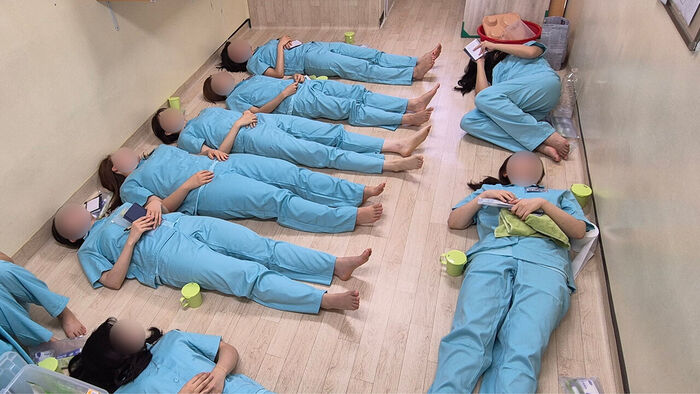
A room of just over 16.62 square meters (5 pyeong), equipped with modest household items, a sink, and a toilet, quickly became packed with no room to step as 12 adult women entered.
Because it was too cramped to stretch out their legs, several had to sit with their backs against the wall and their knees pulled up to their chests.
The room was filled with heat.
Although two wall-mounted fans were running continuously, the heat did not easily subside.
Cheongju Women's Prison, visited by reporters on this day for an inmate experience, is the nation's largest female-only correctional facility. It opened in 1989 and moved to its current location in 2003.
Because it houses a large number of violent offenders and felons who have sparked national outrage, such as Koh Yu-jeong and Lee Eun-hae, it is sometimes referred to as the "Legendary Cheongju" among internet users.
Although it is considered to have relatively better facilities compared to the other 54 correctional facilities nationwide, it suffers from the same chronic overcrowding issues as the others.
While the capacity of Cheongju Women's Prison is around 610, the actual number of inmates stood at 742 as of June 17, bringing the occupancy rate to 120%.
The shared cell experienced by reporters on this day has a capacity of five, but an average of nine inmates are said to live there.
This means nearly two people are crammed into a space meant for one.
The room was cramped even when just sitting, but when lying down, shoulders touched, and one's head would end up near another person's feet.
Only by lying down all the way to the front of the toilet could eight people barely find a spot.
Currently, about half of the 67 solitary cells in the prison are shared by two inmates.
As people are crowded into such tight spaces, inmates become increasingly sensitive, which in turn places a growing daily burden on the correctional officers who manage them.
According to prison officials, only 18 officers manage the entire inmate population during the night shift.
This means each officer is tasked with supervising more than 40 inmates and bearing the burden of preventing various incidents.
A 30-year-old correctional officer surnamed Son lamented, "Shouting matches between officers and inmates are a daily occurrence. It is extremely common for officers to get kicked because agitated inmates cannot calm down."
Indeed, in May, an officer was assaulted while checking on an inmate who had severely damaged the wallpaper in her cell.
In March, an agitated inmate threatened an officer with a wheelchair and kicked the officer in the waist, causing bruises and other injuries.
Another officer said, "There is only one officer managing an entire floor. Since we never know what might happen, we cannot even carry things like batons. Wearing protective gear helplessly is all we can do."
Frequent exposure to various incidents and accidents, including assaults and disturbances, has also worsened the job stress of correctional officers.
According to the Ministry of Justice's 2024 "Mental Health Survey of Correctional Officers," about 20% of the survey participants were identified as being in the "mental health risk group."
Their rate of having planned suicide was about 2.7 times higher than that of the general adult population, and their rate of having attempted suicide was about 1.6 times higher.
The Ministry of Justice cited "heavy workload due to overcrowding and staff shortages" as the biggest factor behind the job stress experienced by correctional officers.
Correctional authorities worry that the poor conditions faced by inmates could weaken rehabilitation and correction functions, thereby increasing the likelihood of recidivism and consequently raising social costs.
In light of this, the Ministry of Justice is seeking a fundamental shift in its correctional policy.
Minister of Justice Jung Sung-ho, who visited Cheongju Women's Prison on this day, said, "The purpose of correction is not simple incarceration, but preventing recidivism and protecting public safety. We will strengthen treatment and rehabilitation programs tailored to the characteristics of female inmates, and build a safe society that citizens can feel, through drug addiction rehabilitation and support for reintegration into society."
He also added, "We will make 2026 the inaugural year of correctional innovation, improving working conditions on the ground and pushing forward with correctional policy reforms centered on treatment, rehabilitation, and resocialization."
※ Please note: This article was translated by AI and may contain errors.
Nine People in a 16.62-Square-Meter Room, 'Double the Capacity'... Cheongju Women's Prison Pushed to Its Limits by Overcrowding
By Yoo Younggyu | Jun 22, 2026